Meet Shelbi, an adult with Developmental Language Disorder, as she shares her experiences
Shelbi Annison is a young adult with Developmental Learning Disorder. She’s an ambassador for an organization called Raising Awareness for Developmental Language Disorders (RADLD). The website states that RADLD is a movement of passionate academics, researchers, health professionals, educators, and families from around the world committed to raising awareness of Developmental Language Disorder (DLD). DLD is diagnosed when children fail to acquire their own language for no obvious reason. This invisible disability affects approximately 1 in 14 children. For reference, 1 in 44 have autism. DLD is sometimes still referred to as Specific Language Impairment. It’s relatively understudied and overlooked by educators and healthcare professionals. So much so in fact, some individuals don’t get a diagnosis until they are older, like Shelbi! Shelbi has been so gracious to agree to share some of her experiences. We exchanged emails to complete this interview. You can find Shelbi on TikTok and Instagram at @dldwhycantyouseeme and on YouTube.
Acey: Where are you from and what’s an interesting fact about you?
Shelbi: Hello my name is Shelbi and I am from the UK. I am an adult with Developmental Language Disorder, Dyslexia, and short-term memory combined. Despite these challenges, I am very creative and full of ideas.
Acey: What education did you pursue?
Shelbi: I received an education through mainstream school. I went to college and completed Level 3 BTEC in Health and Social Care. Never imagined or thought I was ever smart enough to go to University, it was very challenging but they were so supportive, I received a full assessment and support for my Dyslexia! After all the hard-working I was very surprised I was able to graduate from University.
Acey: How do you spend your professional and free time?
Shelbi: I am fortunate enough to work full time and to work for a service which I am very happy and proud to be a part of. The service I work for are very understanding of my difficulties and supportive of my needs. I am aware that this may not be the case for many people due to the lack of understanding and how to support someone with DLD within the working environment.
Acey: Tell us about your journey to understanding your diagnosis of DLD. What were your childhood play and academic experiences like?
Shelbi: My family would say I was quite hyper, energetic, or “naughty” at times. I had difficulty with my expressive language, I would point to what I wanted or needed, my speech was unclear and difficult to understand. This had an impact on my communication and socialising with other children and adults as they struggled to understand what I was trying to say. I would try to copy the play of my siblings or other children. I needed the instructions and rules of the games to be repeated and explained.
In primary school, I used to get frustrated when other people could not understand what I was trying to communicate and if I had difficulty understanding what they were saying to me. I received speech and language therapy to support my speech errors as I had a phonological delay and expressive language delay.
I received some support at secondary school; extra English and maths lessons. My parent paid for a private tutor to help support my academic skills. In year 10 I was diagnosed with Dyslexia because my parent received the diagnosis and it runs in my family with my other siblings. It wasn’t until going to University I feel that I received the most support with my dyslexia and short-term memory difficulties.
I have always struggled with my academic and learning needs; i.e. my speaking and writing skills were not the same, reading, writing, spelling, comprehension, memory, attention and listing, speaking, speech errors, following instructions, understanding spoken or written language etc.
It has always been a challenge to keep up with other people, always having to work extra hard than other people to be able to understand and complete the work. Some teachers did not fully understand but some teachers did understand and were very supportive.
I always received unkind words or comments because I was different from other children. People did not want to play with me. Please don’t worry, you do find people who understand, love, and accept you for being you with all your difficulties and uniqueness.
Acey: When were you diagnosed with DLD?
Shelbi: I was only diagnosed with DLD nearly two years ago. I always felt different to other people and did not know why. I had mixed emotions; sad, angry, worried, happy, and mainly relieved. I was relieved I wasn’t mad or it wasn’t all in my head, there were reasons to explain the difficulties.
Acey: Do you think things might have been different if you had received the diagnosis when you were younger?
Shelbi: This is very a good question, I think it may have made a difference if it had been identified sooner. It is so crucial that early identification and diagnosis are important to ensure that children, young people, and adults are able to receive the right support for them. I will never know in my experience but I do not blame or am upset with anyone for not recognising or identifying my DLD sooner. It is what it is, and it is about what I can do going forward to help raise awareness of DLD so this doesn’t have to be the case for anyone else
Acey: What’s your greatest difficulty living with DLD?
Shelbi: I have great difficulty understanding spoken and written language, expressing my thoughts and ideas clearly, processing information, word-finding and vocabulary, understanding what is expected of me, social cues, and social interaction. What are sarcasm, idioms, and most jokes really?! We can still have a good sense of humour.
I will take longer to understand what I am being told, asked, or instructed to do. I don’t think people truly understand how exhausting it is to live with the difficulties of DLD and how it can impact on our day-to-day lives, tasks, and activities. It is very difficult at times to put into words and explain the impact DLD can have on us.
Acey: What’s something positive you’ve learned about yourself or life after receiving your diagnosis?
Shelbi: It has given me a greater understanding of myself and explained the additional difficulties that I have. I am learning to be more accepting, comfortable, confident, and kind to myself. It is ok to have difficulties, I am perfectly imperfect and I am ok with that
I understand this may be a shock for some people to receive and they need more time to come to terms with their diagnosis. That is ok!
Receiving a diagnosis of DLD shouldn’t feel like a life sentence or feel that you will never be fulfilled, succeed or achieve the things that you want to do in life! There will be some barriers but there are so many positives to having DLD as well!
More awareness of DLD in the wider community, schools, colleges, universities, all professionals and workplaces will better the equality of life for someone will DLD by having equal opportunities and being able to live the life that they deserve!
Acey: How did you become involved with RADLD?
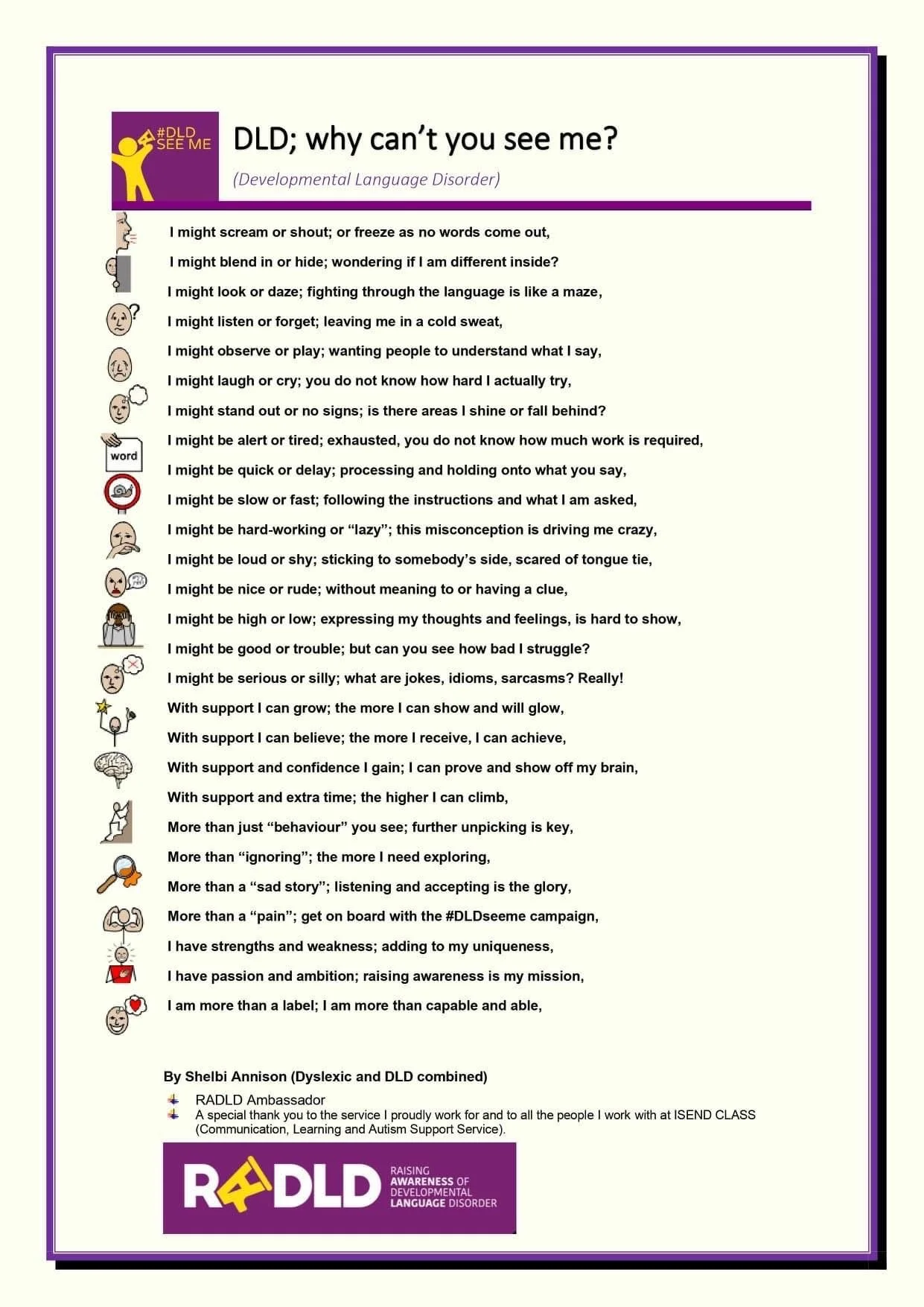
Shelbi: I was recommended their website for further information and support. I became passionate and wanted to help to raise awareness of DLD through my unique experience. Where I started to become one of their RADLD Ambassadors; supporting and raising awareness of DLD. I wrote the “DLD; why can’t you see me?” Poem and continue to raise awareness through my DLD; why can’t you see me? Awareness accounts.
Acey: When you were younger (and now!), did you experience difficulties with certain types of games, puzzles, or toys due to the nature of their instructions or language related to understanding the product or program? If so, what products were they, and what was your experience like?
Shelbi: I always had difficulties understanding or recalling the instructions for games, apps, or software. I require additional support to understand how to use these; i.e. someone reading and explaining the instruction to me as the instructions manuals are overwhelming and confusing, the language or vocabulary used can be difficult to understand or comprehend, modeling step by step how to play the game or how to use the app/software, use of step by step clear pictures and simplified language, use of video going through how to use the app/software is very useful and helpful.
I always enjoyed very simple games or practical games like; Jenga, connect four, snakes and ladders, donkey buckaroo, Uno/ cards games, guess who, mousetrap, battleships, cluedo, twister, operation, pop up pirate, Monopoly
Acey: What do you want people to understand about DLD?
Shelbi:
Developmental Language Disorder (DLD) is a significant difficulty learning, understanding, and using spoken language.
DLD is much more than just a delay, it is a life-long condition, which presents in children and continues into adulthood.
DLD is very common, 1 in 14 children have DLD and it affects people all around the world. Everyone with DLD is different!
All behaviour is a form of communication! It is so important to build an overall view of the child, young people or adult’s strengths and needs.
DLD can have an impact on an individual’s emotional and mental wellbeing. We are most likely internalise behaviours like anxiety and depression. Please know you are not alone! We are here for you!